
Categories
Housing Market & Home Value, Market Trends & InsightsPublished June 10, 2026
The Mid-Year Housing Market Update: Why Forecasts Changed in 2026


If the housing market feels confusing right now, you're not alone. Mortgage rates have increased, home sales haven't gained momentum the way many expected, and both buyers and sellers are wondering when affordability and market conditions will improve.
The reality is that a lot has changed during the first half of this year.
At the end of 2025, economists were forecasting a much stronger housing market in 2026. Expectations were that mortgage rates would decline, affordability would improve more significantly, and home sales would rebound.
Instead, lingering inflation, ongoing economic uncertainty, and growing geopolitical tensions overseas pushed mortgage rates higher than anticipated. Because rates remained elevated for longer than expected, many buyers continued to stay on the sidelines.
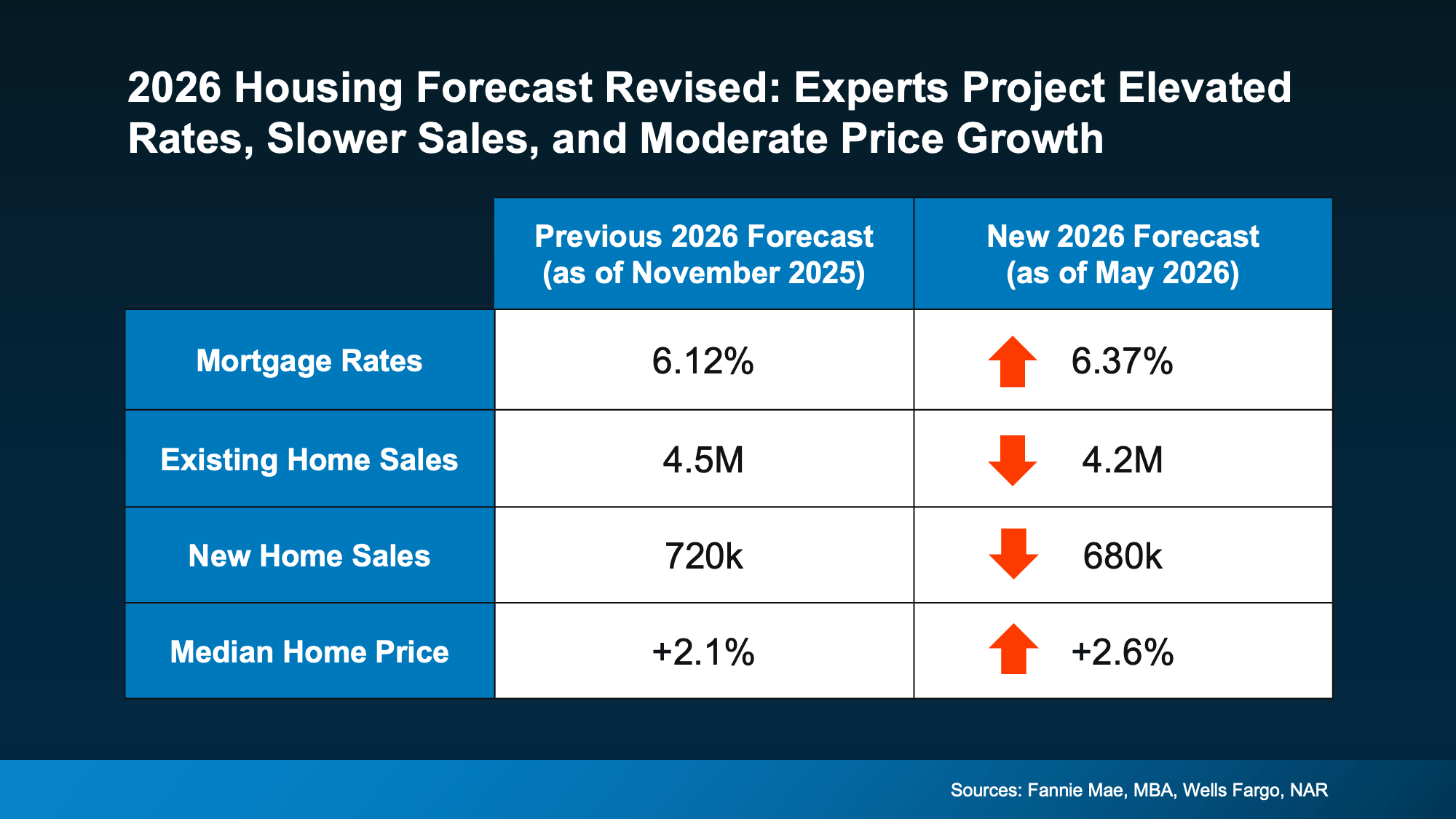
As a result, experts recently revised their housing forecasts for the remainder of the year (see graph below).
What Does This Mean for You?
Let's take a closer look.
Mortgage Rates May Remain Elevated
While just about everyone would like to see mortgage rates return to the upper 5s or low 6s we saw at the start of the year, experts don't believe that's likely to happen in 2026.
Forecasts have shifted from the low-6% range that was originally projected. Many industry organizations now expect mortgage rates to remain in roughly the mid-6% range throughout the year. The good news is that rates are still lower than they were a year ago.
Of course, forecasts are based on current conditions. If overseas conflicts ease or inflation falls more quickly than expected, projections could change. But for anyone waiting for significantly lower rates, that strategy may not deliver the results they're hoping for.
Existing Home Sales Revised Lower
Back in late 2025, experts expected approximately 4.5 million existing homes would sell this year. Today, that forecast has been adjusted down to about 4.2 million.
That revision highlights an important reality: affordability challenges continue to keep many buyers hesitant.
Higher mortgage rates have made monthly payments more difficult to manage, particularly for first-time buyers, slowing the pace of the market compared to earlier expectations. Even so, despite the downward revision, existing home sales are still projected to exceed last year's total.
Many experts believe that once geopolitical tensions ease and mortgage rates begin to stabilize, a large group of waiting buyers will be ready to re-enter the market. As Lawrence Yun, Chief Economist at NAR, explains:
"There is sizable pent-up demand that could be released into the market."
There have already been a few encouraging signs. In recent months, pending home sales have improved month-over-month despite higher mortgage rates.
So, if you're financially comfortable purchasing at today's rates, buying now may still make sense. Waiting could mean facing more competition—and potentially fewer available homes—once other buyers begin jumping back into the market.
New Home Sales Also Slowed
Builders entered 2026 expecting a stronger year as well. Earlier forecasts projected new home sales would surpass 700,000 this year. Now, economists expect sales to come in just below that mark.
Once again, mortgage rates are a major factor.
However, there may be an opportunity for buyers. Builders could be even more motivated to sell, which may lead to continued incentives, greater pricing flexibility, and additional negotiation opportunities in many markets. If you live in an area with a significant amount of new construction, this could be a bright spot.
With builders potentially more willing to negotiate, buyers may have additional leverage to secure a better deal.
Home Prices Are Still Expected To Rise
Here's what the updated housing forecast means if you're buying or selling in Lubbock or West Texas.
Even though sales activity has slowed, experts have not revised their national home price forecasts downward. They still expect home prices to rise this year.
Why? Because while buyer demand has softened, the overall supply of homes for sale remains relatively limited. That imbalance continues to support home values, even in a slower market environment.
Of course, every market is different. Some areas are cooling more than others. But nationally, experts continue to project steady price growth rather than a significant decline. Here in West Texas we've also seen much more stable numbers in regard to both mortgage rates and overall home prices, as well as comparatively less time that listings spend on the market compared to other states and larger metropolitan areas.
That's encouraging news whether you're buying or selling.
Sellers generally don't want to see a major drop in home values. And while buyers may think lower prices sound appealing, most people feel more confident making a large purchase when it isn't expected to depreciate shortly afterward.
Bottom Line
The housing market hasn't rebounded as quickly as experts originally anticipated, but that doesn't mean it has stalled.
Higher inflation and ongoing economic uncertainty have led economists to revise their forecasts for 2026. Importantly, many experts believe the market can regain momentum once those factors begin to ease.
Rather than viewing these forecast revisions as a sign of trouble, consider them a temporary response to current economic conditions and uncertainty.
If you'd like to know what's happening in our local market—and what it could mean for your plans during the rest of this year—let's connect.

Jenifer Hudman
| Jenifer Hudman - Keck Real Estate | Keller Williams Realty - Lubbock
or another way